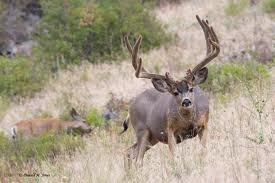
"Big bucks don’t want to be found, and that’s exactly why they are so hard to find."
Have you ever wondered why some hunters are wildly successful while others--maybe even you--struggle?
Great news: I know precisely why. And the even better news is that the truth behind what makes some hunters successful, while others struggle, can be learned.
You may or may not know this, but when I was young, I couldn’t hunt my way out of a brown paper bag. I stumbled, failed, and learned a lot of lessons throughout the years. In fact, I’ve spent the decades since then perfecting those lessons, culling them down into a science.
I'm going to share my experience with you!
My book, Blood in the Tracks, is the tale of my journey towards hunting success – the funny, exhausting, heart-stopping whole of it – PLUS the lessons it taught me, and how you can apply those lessons to your deer hunting.
In 170 pages, I unravel one of hunting greatest mysteries: trophy mule deer success. Why do some people seem to experience it almost effortlessly, while others seem to seek it continuously?
And is it possible to become a more successful hunter? The short answer is, yes. It takes some mind-shifting, some serious thinking, and even some hard-to-make habit changes – but in the end, you have the potential inside of you to achieve the success you crave.
Jim
Learn more here
http://jimcollyer.com/
Friday, July 26, 2013
Wednesday, July 24, 2013
Relocating Summer Bucks
I did just that a couple of years ago. I found a promising ridge and decided to walk it out. The first basin was deserted, and so was the second. In the third basin, I found the deer. I watched the bucks until they bedded for the day.
Stay as far away from the deer as possible. The damage from overscouting is always irreparable.
Jim
More on Scouting Here
http://jimcollyer.com/
Monday, July 22, 2013
Early Season
The key to early-season hunting is food sources. The bucks are gorging
themselves to build fat reserves for the upcoming rut and winter. The largest
bucks will be found in the best and most abundant food source in the area. The
bucks’ actions and movements are much more predictable now.
Jim
Sunday, July 21, 2013
Scouting Mule Deer
Great hunters spend far more time investigating
(scouting) than they do hunting. Good hunters are good detectives and have
honed their investigative (observation) skills. Good scouting is not so much
looking for answers as it is looking for the questions. In nature, nothing is
random and nothing happens by accident. The when
and the where are a lot easier to
figure out if we know what makes the wheel go around.
Jim
Friday, July 19, 2013
Fast and Easy Scouting
Rule #1 Don’t ever walk into a bedding area while either scouting or hunting. Above all else these areas are sacred. If you jump a big mule deer buck from his bed he will NEVER bed in that same spot again that season.
Before I ever enter a new area I want an aerial view of what I’m looking at. 20 years ago we had to rent planes to learn new areas ( very expensive). Today we have "Google Earth". If you don’t have "Google Earth" on your computer, stop right now and download it. It is probably the most priceless hunting tool (other than your gun or bow) in the world. I use it almost daily.
Here is what I’m looking for on Google:
#1 ROCKSMule deer love rocks. I’m always looking for rocky outcrops that are facing either north, northeast, or even east. These are prime bedding areas throughout the summer and fall months for the shade they provide. In addition these outcrops provide a multitude of escape routes. The further these rocky areas are from public access the better. Rocky outcrops are a big buck magnet. Remember we are hunting during the daylight hours and big bucks like to be bedded during those hours. The biggest bucks like to bed in the same spot all day, only standing up a couple of times to stretch their legs and then plop down again.
#2 "QUAKIE" THICKETS
Next I look for dark green patches of vegetation. These could indicate an Aspin thicket. Early in the season bucks seek Aspin thickets even more than the rocks. Most inexperienced hunters associate these "quakie" thickets with water. Nothing could be further from the truth. Rarely is there ever found standing water in an Aspin thicket. The bucks are drawn to these areas because the ground is cooler in a Aspin patch than under any other shade source. If you don’t believe me try it, put your hand on any other shaded ground and on the ground under an Aspin grove. You will be able to tell the difference and so can the bucks.
#3 WATER
After I have located suitable bedding areas I look for water. Slow moving or stagnant water is always best. I’m looking for springs, marshy ground, irrigation ditches, and even farming pivots. I’m looking for water sources that are within 2 to 3 miles of the bedding areas. Mule deer don’t go to water everyday, but at least once every three days for sure. The problem with hanging your hat on a watering hole is that the bigger bucks will often water at night. Not because of human pressure, but because they tend to avoid crowds.
Once I’ve located several likely spots and marked them on a map its time to grab my binoculars and let the rubber hit the road. I’m still not looking for deer. This time I’m looking for feed. In the northern ranges I’m looking for Redstem Ceanothus or Pachystima (Myrtle Boxwood). In more arid terrain I’m looking for Purshia Tridentata ( antelope bitterbrush).
Learn to recognize the preferred food sources in your hunting area. Being able to distinguish these at a great distance will increase your odds tremendously. If you find a secluded area with rocks, redstem, and yellow pine, you’ll find big deer in the northern Rockies. Likewise with bitterbrush in the desert. You don’t have to get any closer, the buck will be there. Find a high ridge and glass from a distance. Be careful to avoid the skyline as the bucks will see you from miles away. Be patient, the idea is to intercept the deer between bedding and feeding areas. Lean towards the feeding areas as the buck will return there if disturbed, but he will NEVER return to a bed once disturbed there. ( Rule #1)
Good Luck and Good Hunting,
Jim
Good Luck and Good Hunting,
Jim
Wednesday, July 17, 2013
Are Mule Deer Smart?
Because mule deer have the tendency to stop and look back
They might be more curious than other deer, but they certainly
aren’t stupid. The fact that mule deer have the largest brain of
any deer on earth should be ample proof of their intelligence.
Jim
Get your copy of the book here
http://jimcollyer.com/
Monday, July 15, 2013
Cancel Your Mistakes
If you could cancel all of the mistakes you've ever made hunting Mule Deer................
You would multiply the number of bucks you've harvested by a factor of three or four. We make mistakes every time we go into the woods. With this in mind I've written a new book on trophy mule deer hunting, "Blood in the Tracks".
I'm going to be giving you some tips and pointers on how to avoid those mistake through this blog.
I look forward to sharing my ideas with you and hope this information will elevate your success.
Good luck to all of you this coming season.
Jim
Grab a copy of the book here
http://jimcollyer.com/
Subscribe to:
Posts (Atom)


+(4).jpg)