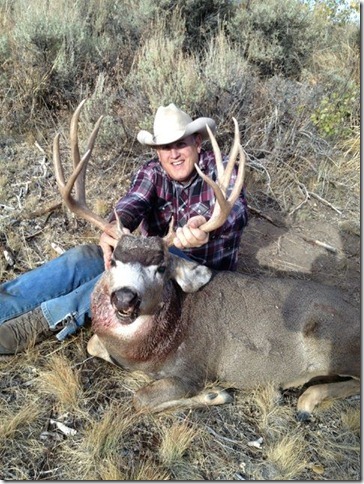
95% of Mule Deer hunters surveyed indicated they wanted to harvest a trophy buck.
Unfortunately, only about 5% of hunters harvest trophy class bucks each year and only 1% harvest trophy class bucks year after year. Are you one of them?
Interestingly, only about 1% of hunters read books on hunting. Maybe they know something you don’t.
Close the gap and join the 1 precentors.
Jim
Tuesday, January 28, 2014
Wednesday, November 20, 2013
The way to bigger bucks
Here's an exercise for you; imagine that it's possible for you to harvest bucks much bigger than you currently are. If you're taking 150" bucks, imagine for a moment that it's possible for you to take 180" bucks consistently.
The first reaction of most people to that exercise is to smile briefly and then to begin thinking about why it isn't possible. One man said to me, "If you knew how hard it's for me to harvest the quality of bucks I’m currently taking, you wouldn't be suggesting that I could start harvesting larger bucks consistently."
Well, my response to that is "Don't sell yourself short."
Mark Twain once wrote: "there are a thousand excuses for every failure but never a good reason."
The truth is, the average American hunter has the potential to harvest far bigger bucks than he or she is doing currently.
That's why I created a special book for you called "Blood in the Tracks."
Grab your copy today
Increase your hunting potential today,
Jim
Labels:
mule deer hunting,
Mule Deer Rut,
Muley,
Mulie,
Trophy Mule deer
Monday, November 18, 2013
Hitting Running Deer
If you can’t hit a running animal, you’re missing a lot of action.
Why is it shooting at a standing bird (ground sluicing) is considered un-sportsman like, while shooting at a running deer is un-ethical. For the life of me, I can’t see the difference.
Hitting running deer can be a daunting task even for experienced shooters. However, there are a few tricks, which will greatly improve your shooting performance at running deer.
There are two schools of thought on hitting running game with a high powered rifle. They are the swing through and the sustained lead.
Swinging through the deer is the same as swinging a shotgun at a flying bird. The hunter moves the cross-hairs through the target and squeezes the trigger when the cross-hairs pass the intended target.
Sustained lead is just that. The hunter leads the deer with his cross-hairs and hopes the deer runs into the bullet. Unfortunately, this rarely works out.
A rifleman with a good swing is about 5 times more successful at hitting running game than one using the sustained lead method.
Here’s how to master the swing:
Mounting the Rifle
One common mistakes most hunters make is properly mounting the rifle. The tendency is to bring the butt of the rifle up to your shoulder. The butt of the rifle can easily get hung-up on our heavier hunting jacket making it difficult to get a consistent mount. It’s best to practice pushing the rifle away from your body and then bringing it straight back to the shoulder. Good shooter practice their mount before they go to the range.
Gripping the Rifle
Learning to mount your rifle properly will ensure a good solid anchor of the rifle to your shoulder. Equally important is learning how to properly grip the forearm. A good shooter will extend their index finger and aline it with the barrel. Where the finger points, the barrel also points. This makes it a lot easier to follow the deer with the muzzle.
Trigger Pull
A good trigger pull will greatly improve your shooting at all game, moving or not. Factory triggers tend to be stiff, have excessive pull or both. A hunter should never have to force the trigger. If you have to put too much pressure on the trigger or there is too much slop in the pull, you’re likely to slow or even stop your swing causing a miss. The rifle should go off easily when the hunter wants it to. I like my hunting trigger to be crisp, with a pull between 2 and 3 pounds. Any gunsmith can help you adjust your trigger to the proper pull.
Swing and Follow Through
A good swing and follow through is a lot like playing baseball. The batter keeps his eye on the ball and doesn’t stop his swing when he hits the ball. He follows through. Likewise, a batter has to time his swing to make contact with the ball. If he gets excited and swings too fast or too slow, he’ll miss the ball all together. These same principle apply to shooting.
Our natural tendency is to stop the swing once the rifle goes off. This inevitably causes our shot to land behind the deer. If we swing too fast or try to speed up our swing, we’ll shoot in front of the deer. Practicing your swing and follow through is essential if you want to become an accomplished shot at running game.
It’s best to keep the rifle moving at the same speed as the deer and slowly increase the speed of the muzzle and squeeze the trigger when the cross-hairs pass through the deer.
Just like a batters focus is on the ball and not the bat, our focus should always be on the deer not the cross-hairs. If we shift our focus between the deer and the cross-hairs, our swing will be erratic and we’ll miss.
Hitting running deer isn’t easy. It never is. However, if you follow these four simple tricks, you’ll greatly improve your odds at hitting the running buck.
Jim
Labels:
mule deer hunting,
Muley,
Mulie,
Trophy Mule deer
Tuesday, October 15, 2013
Mule Deer Rut
What’s most important to remember about the rut, is that it’s about the does not the bucks. The doe will only be in heat for about 24 hours. If you miss that opportunity, you missed your opportunity. The short answer to hunting the rut is; do what the bucks are doing, hunt doe groups.
Jim
More on the rut here
http://jimcollyer.com/
Jim
More on the rut here
http://jimcollyer.com/
Monday, September 30, 2013
Feeding Patterns
Ambushing deer on their way to a primary food source is one of the best ways to harvest trophy animals. However, a hunter who understands a deer's feeding pattern during the middle of the day will be more successful year in and year out. Take time to find out what plants the deer feed on during the day and plan to hunt those areas this fall. If left undisturbed the deer will bed right in the middle of these spots. It’s always best to play in front of the deer and getting into these spots before the deer do is essential.
Jim
http://www.amazon.com/Blood-Tracks-Mule-Deer-Manifesto/dp/1470168987
Jim
http://www.amazon.com/Blood-Tracks-Mule-Deer-Manifesto/dp/1470168987
Monday, September 16, 2013
Early Season Mule Deer
Believe it or not, most early season mule deer are killed while spotting and stalking. It isn’t the best tactic, in fact 80% of the deer will spook before your in range. Stalking to within range works best with a strong wind to blow both your scent and the sound of your approach away from the deer.
I avoid stalking bedded deer unless it is a last resort. The problem is if you spook the deer (and you probably will), they won’t return to that bed again this season and you’ll be left looking for another buck.
A much better way to hunt early mule deer is to wait in ambush between feeding and bedding areas. Look for trails with rubs, droppings, and nibbled plants, This is where you’ll want to wait in ambush.
If the wind is right and you don’t get a shot, you’ll be able to setup on the same deer agin tomorrow.
Jim
http://www.amazon.com/Blood-Tracks-Mule-Deer-Manifesto/dp/1470168987
I avoid stalking bedded deer unless it is a last resort. The problem is if you spook the deer (and you probably will), they won’t return to that bed again this season and you’ll be left looking for another buck.
A much better way to hunt early mule deer is to wait in ambush between feeding and bedding areas. Look for trails with rubs, droppings, and nibbled plants, This is where you’ll want to wait in ambush.
If the wind is right and you don’t get a shot, you’ll be able to setup on the same deer agin tomorrow.
Jim
http://www.amazon.com/Blood-Tracks-Mule-Deer-Manifesto/dp/1470168987
Sunday, September 8, 2013
How the Zen Approach Can Help You Be a Better Hunter
Even if you're the type who would rather eat worms than meditate, getting a little Zen can improve your hunting:
Don't Get Attached
In Zen-speak, it's called "being attached"—that is, caring so much about harvesting a big buck or an outcome that you're disappointed when you can't have it. Don't get attached to your tactics, because you may change them. Don't get attached to the idea of Getting into Boone & Crockett, because if it doesn't happen you may be too discouraged to keep plugging away.
Simplify, Simplify
Zen practitioners urge people to make do with less. Not only will this simplify your life—it will help your hunting. Go through your equipment and gadgets and throw away all unnecessary items. This will be about 90% of them. Don't buy into the latest complicated, expensive hunting fad, it won’t help.
Be Mindful
Do what you're doing. When you're hunting-hunt-don’t be think about your partner, job or what you have to do tomorrow. Being mindful will help you become more productive—and less stressed while you’re hunting..
Happy hunting!
Jim
http://www.amazon.com/Blood-Tracks-Mule-Deer-Manifesto/dp/1470168987
Don't Get Attached
In Zen-speak, it's called "being attached"—that is, caring so much about harvesting a big buck or an outcome that you're disappointed when you can't have it. Don't get attached to your tactics, because you may change them. Don't get attached to the idea of Getting into Boone & Crockett, because if it doesn't happen you may be too discouraged to keep plugging away.
Simplify, Simplify
Zen practitioners urge people to make do with less. Not only will this simplify your life—it will help your hunting. Go through your equipment and gadgets and throw away all unnecessary items. This will be about 90% of them. Don't buy into the latest complicated, expensive hunting fad, it won’t help.
Be Mindful
Do what you're doing. When you're hunting-hunt-don’t be think about your partner, job or what you have to do tomorrow. Being mindful will help you become more productive—and less stressed while you’re hunting..
Happy hunting!
Jim
http://www.amazon.com/Blood-Tracks-Mule-Deer-Manifesto/dp/1470168987
Labels:
mule deer hunting,
Muley,
Mulie,
Trophy Mule deer
Friday, September 6, 2013
Mid-day
Many hunters are under the impression that big deer only feed at night. While deer are primarily nocturnal, they can’t go all day without feeding. The demand for nutrition is just too great. A buck must feed at least every couple of hours, even if it is a small amount. A deer is most vulnerable when feeding and they eat very fast. During the day buck will bed right in a food source if possible. He can stand up, feed for a few minutes, and lay back down without much movement. This has been the undoing of a lot of bucks.
Jim
http://www.amazon.com/Blood-Tracks-Mule-Deer-Manifesto/dp/1470168987
Jim
http://www.amazon.com/Blood-Tracks-Mule-Deer-Manifesto/dp/1470168987
Wednesday, September 4, 2013
Don’t Give Up on Mid-day Hunting
Most hunters are gone by 11:00 am, and most of the
deer know this. A mature buck will often
get out of his bed and feed for a few minutes around mid-day. This is an excellent time to catch a buck
feeding or looking for does. Staying in the field will produce more
opportunities than eating lunch.
Jim
Sunday, September 1, 2013
Staying Flexible in a Changing Hunting Environment
Think of yourself as stretchable, expandable, and able to adapt to anything new. Who wants to view themselves as static, inflexible, and unable to adapt? Changes in the hunting environment are unpredictable, and we will be asked to adapt to changes we never anticipated.
When changes occur it’s best to think ahead, but not too far ahead. Instead of abandoning our efforts, focus on changes we can make in the immediate future. I mean think of how you can get ahead of the deer, not next time, but right NOW!
The most important strategy for staying flexible during change is to prepare for various change scenarios. If we create a plan for each possible set of change circumstances, we are prepared to engage change in any way that affects us in the field.
Jim
Get the Book
When changes occur it’s best to think ahead, but not too far ahead. Instead of abandoning our efforts, focus on changes we can make in the immediate future. I mean think of how you can get ahead of the deer, not next time, but right NOW!
The most important strategy for staying flexible during change is to prepare for various change scenarios. If we create a plan for each possible set of change circumstances, we are prepared to engage change in any way that affects us in the field.
Jim
Get the Book
Labels:
deer migration,
mule deer hunting,
Muley,
Mulie,
Trophy Mule deer
Wednesday, August 28, 2013
My Secret Buck Lure
People often ask, "Where do you find all those bucks?"
Sometimes, I let the bucks find me.
I started using this tactic over 40 years ago and my ability to get close to mature mule deer in heavy timber increased dramatically. I actually doubled my encounter with trophy sized mule deer.
HER IS MY SECRET LURE:
I started saving the hock glands from the bucks I had taken. The next season I cut slits in them and laced them on to my hunting boots. Not only does this help to cover-up any human odor, but it also leaves a small amount of residual deer odor on the ground, which attracts bucks to you.
I can’t guaranty you have the same results I have had, but it worked like a charm for me.
Learn more on trophy mule deer here
Jim
Sunday, August 25, 2013
Insanity
If you hunt the way your father or uncle hunted, then you can’t expect to kill any more or bigger deer than they did.
Albert Einstein said, "Insanity is doing the same thing over and over again and expecting different results."
We must be willing to change ourselves and the way we hunt if we expect to change our results.
Become a better mule deer hunter now
-Jim
http://jimcollyer.com/
Friday, August 23, 2013
Look for the Questions
Good scouting is not so much looking for the answers as it is looking for the questions. In nature nothing is random and nothing happens by accident. The when and the where are a lot easier to figure out if we know what makes the we’ll go around.
Scouting tips
Wednesday, August 21, 2013
The Difficult Part
The most difficult part of becoming a great hunter is making the commitment to be one. Trust me: it’s much more difficult to be an average hunter than it is to be a great hunter.
-Jim
Monday, August 19, 2013
The Stink Buck
The bucks, for their part, secrete their own strong hormones to help induce the females to ovulate. Researchers have long understood the effects of male odors on hormone levels in females, and have found that the length and timing of the menstrual cycles are markedly influenced by odors produced by males. This is why big bucks will always enter the field upwind of the doe herd. Not only does this promote estrous, but also the buck can visually detect even the slightest sign of sexual arousal his scent might be causing in the doe.
Get a copy of "Blood in the Tracks"
Labels:
mule deer hunting,
Mule Deer Rut,
Muley,
Mulie,
Trophy Mule deer
Saturday, August 17, 2013
Sit Quietly
While tracking deer is the best way to learn about an
individual animal, I don’t know of any other method that propels a hunter into
the rhythm of the forest quicker than sitting quietly. It’s hard to control
anything when you’re sitting still. The hunter has no choice but to observe and
become a student of nature. This is the best way to experience the harmonic
relationships of nature.
grab the book here
Jim
http://jimcollyer.com/
Labels:
deer migration,
mule deer hunting,
Muley,
Mulie,
Trophy Mule deer
Thursday, August 15, 2013
Mule Deer Migration
Mule
deer migrate along the same corridors or routes year after year. Migration
trails are rarely found on ridge tops or in the bottoms. Most of these trails
are located about a third of the way down the slope. Although the deer seem to
show up out of nowhere, the truth is a deer’s migratory journey can take
several days to several weeks to complete. In some areas, the deer need to
migrate only eight to twelve miles to reach their winter range. In other areas,
the deer will travel as far as 160 miles each fall. The deer will travel three
to four miles and then stop over in much the same way people do when taking a
long trip.
Jim
Labels:
deer migration,
mule deer hunting,
Muley,
Mulie,
Trophy Mule deer
Tuesday, August 13, 2013
Mule Deer Rut
Learn more on what triggers the rut
Sunday, August 11, 2013
Tracking Mule Deer
Tracking is the only way to learn everything there is
to know about the deer in any location. The tracks tell all. They can tell you
the age and sex of the deer you are following. They will show you where the
buck travels in the morning, where he travels in the evening, where he feeds,
and where he sleeps.
I grew up in the era before camouflage and six-hundred-yard
rifles. When deer season came, we tracked deer from dawn until dark. It was not
only great fun, but also a great lesson in life. Do a kid a favor and put him
on a set of tracks. Tell him not to come back until he kills the deer or it
gets dark. If he comes back wide-eyed and excited, he’ll be a hunter for life.
If he comes back bored and resentful, you can always buy the kid a set of golf
clubs.
More on tracking mule deer.
Jim
http://jimcollyer.com/
More on tracking mule deer.
Friday, August 9, 2013
Still-hunting
Still-hunting
is a solo sport, and few hunters can become proficient at it. Still-hunting can
be learned only after many hours and seasons of practice. It’s a rewarding
experience for those who have the necessary time, patience, and persistence.
Become a better still-hunter now
Jim
http://jimcollyer.com/
Become a better still-hunter now
http://jimcollyer.com/
Labels:
mule deer hunting,
Mule Deer Rut,
Muley,
Mulie,
Still-Hunting,
Trophy Mule deer
Subscribe to:
Posts (Atom)